
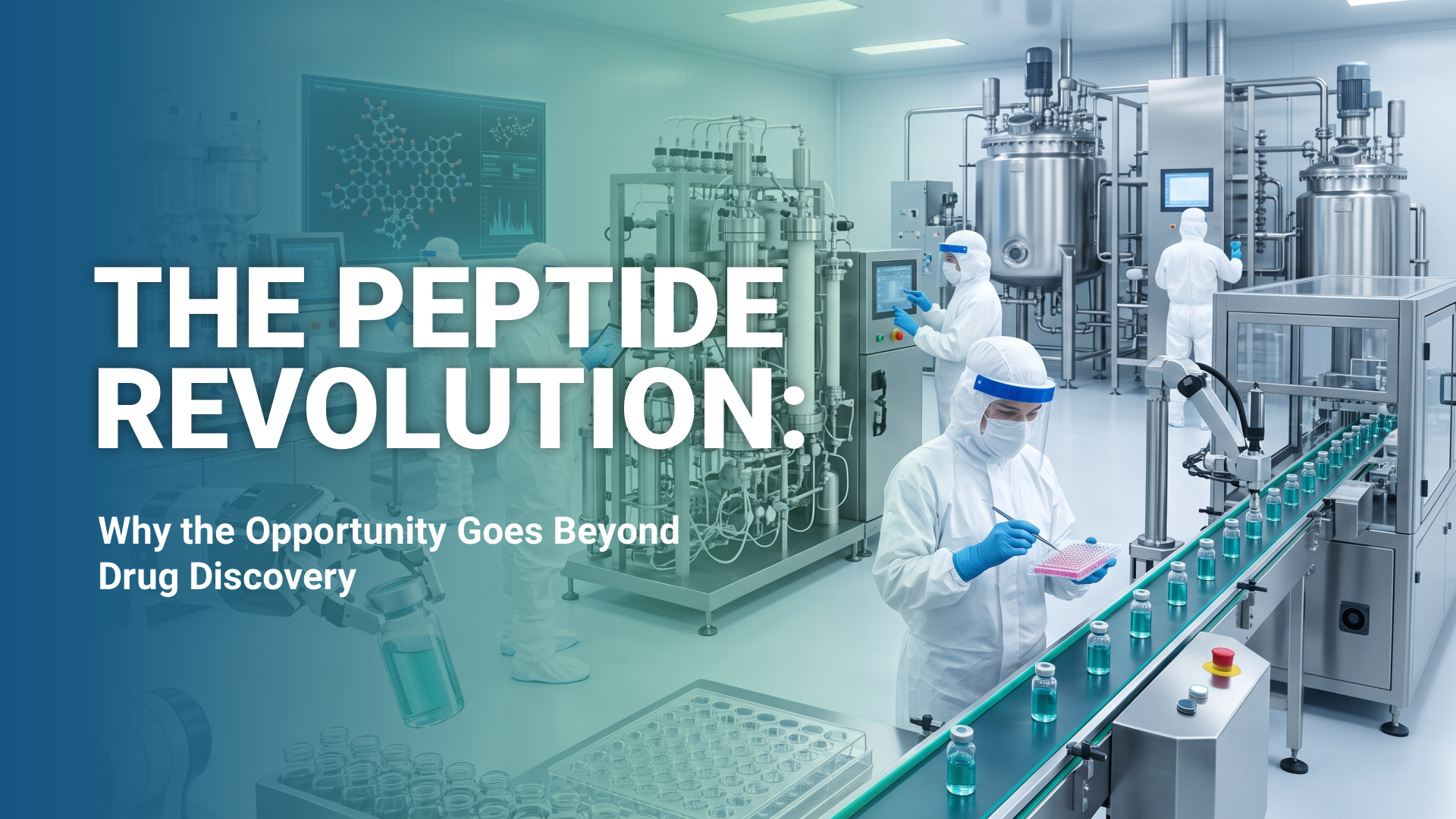
Why the Opportunity Goes Beyond Drug Discovery
Peptides are moving rapidly from specialist laboratory science into one of the most important areas of pharmaceutical innovation.
The success of GLP-1 medicines such as semaglutide and tirzepatide has transformed the economics of peptide therapeutics, attracting investment not only into drug development but across the wider ecosystem—including manufacturing, delivery technologies, analytical services, and specialized CDMOs.
From Biology to Molecular Engineering
Peptides can interact with biological systems with remarkable specificity. Advances in chemistry and drug delivery are now helping overcome traditional limitations such as short half-lives and poor oral absorption.
Technologies including lipidation, sequence engineering, conjugation, and long-acting formulations are turning peptide development into increasingly sophisticated molecular engineering.
The Next Wave: Multi-Target Therapies
The field is moving beyond single-target approaches.
Investigational programs such as retatrutide are exploring multiple metabolic pathways simultaneously, while amylin-based approaches such as CagriSema are adding new dimensions to obesity pharmacology.
At the same time, longer-acting therapies could make dosing frequency an important competitive advantage.
Manufacturing Could Be the Real Bottleneck
Discovering a promising peptide is only the beginning.
Producing pharmaceutical-grade material consistently at commercial scale requires sophisticated synthesis, purification, analytical testing, and quality control.
As molecules become more complex, manufacturing capacity and analytical infrastructure become increasingly strategic assets.
This creates opportunities across the value chain:
API manufacturing → Purification → Analytical testing → Formulation → Fill-finish → Drug delivery
A Growing Regulatory Divide
Alongside regulated pharmaceutical development, an online market for experimental peptides has also expanded.
Compounds such as BPC-157, TB-500, MOTS-c, and others are widely discussed online. But scientific interest is not equivalent to clinical evidence or regulatory approval. The distinction between an experimental molecule and an approved medicine remains critical—and increasingly important as regulators address products marketed outside conventional drug-development pathways.
Where Is the Opportunity?
The peptide revolution is bigger than the search for the next blockbuster drug.
For investors, manufacturers, biotech companies, and technology providers, the opportunity may lie across the entire ecosystem—from peptide synthesis and analytical capabilities to advanced delivery systems and specialized manufacturing.
The key question is no longer simply:
“What is the next promising peptide?”
It is:
“Who can turn promising peptide science into a reproducible, scalable, high-quality and commercially viable medicine?”
That may be where the next major opportunities in the peptide economy emerge.
How Ambileap Can Help
At Ambileap, we help businesses identify and evaluate opportunities across emerging markets, technologies, ingredients, manufacturing, and applications.
Whether you are looking for a technology partner, manufacturing capability, market opportunity, supplier, or new application, we can help turn complex questions into actionable insights.
Have a business question? Let’s explore the opportunity.